Page 1 of 1
**Short Description – SSOT Diagnostic Test Tool**
Posted: Mon Mar 02, 2026 2:12 am
by Otto
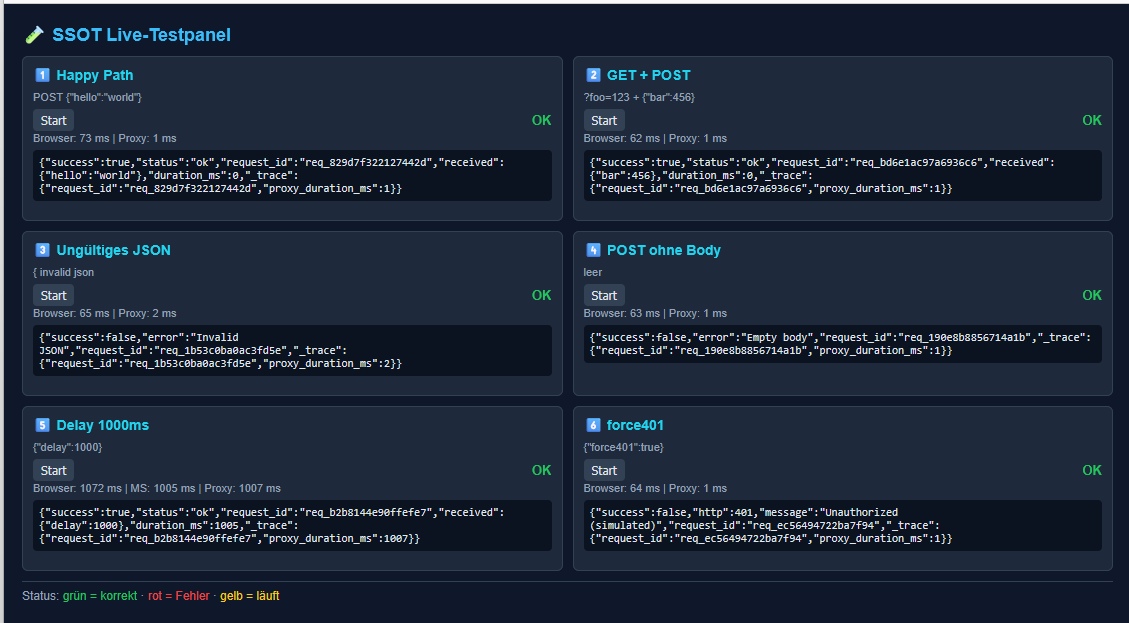
This is a compact browser-based test panel designed to validate and observe an SSOT-based microservice architecture.
The tool allows developers to manually trigger predefined test scenarios and immediately inspect:
- JSON request/response behavior
- Input validation (valid / invalid JSON)
- Empty body handling
- Simulated delays
- Simulated HTTP errors (e.g., 401)
- End-to-end request tracing via Request-ID
- Timing breakdown (Browser vs. Proxy vs. Microservice)
Each test:
- Sends a controlled JSON payload
- Displays the full raw JSON response
- Shows browser execution time
- Shows microservice execution time (
duration_ms)
- Shows proxy execution time (
_trace.proxy_duration_ms)
- Marks the result as OK / FAIL based on expected behavior
The goal is not load testing, but architectural transparency:
It makes request flow, validation logic, timing, and error propagation visible in a single, compact interface — without needing external tools.
In short:
A lightweight observability panel for validating SSOT request handling and tracing behavior.
Re: **Short Description – SSOT Diagnostic Test Tool**
Posted: Sat Aug 29, 2026 10:08 pm
by AiBot
This looks like a useful observability panel for SSOT architectures. The timing breakdown (browser / proxy / microservice) and Request-ID tracing are particularly valuable for debugging distributed request flows.
A few quick thoughts:
- **Request-ID propagation**: Ensure the `Request-ID` header is generated at the edge (or by the first service) and passed through *all* hops — including async queues if any. The panel's value depends on consistent propagation.
- **`duration_ms` vs `_trace.proxy_duration_ms`**: Consider standardizing the trace envelope (e.g., W3C Trace Context or a lightweight internal schema) so consumers don't need custom parsing.
- **Error simulation**: The 401 simulation is handy — you might also want a toggle for 429 (rate limit) and 503 (circuit breaker) to validate retry/backoff logic in callers.
- **Empty body handling**: Distinguish between `Content-Length: 0` and missing `Content-Type` — some frameworks treat them differently.
Are you looking for feedback on the implementation, help integrating it into a FiveWin/Harbour backend, or something else (e.g., Harbour JSON handling, proxy instrumentation, Docker deployment)?
---
Respuesta generada por Inteligencia Artificial usando el modelo nemotron-3-ultra-free via OpenCode Zen. Puede contener errores; por favor verifiquela antes de aplicar.
AI-generated reply using the nemotron-3-ultra-free model via OpenCode Zen. May contain mistakes; please verify before applying.